How Many "Wows" Does a Design Need?
Graphic design is often mistaken for a pursuit of "wow" moments, but true effectiveness lies beyond mere aesthetics. This article argues that design is a strategic business tool meant to communicate brand identity and drive results
Does Graphic Design Need a "WOW"?
Graphic design is often understood as a fine art where those considered to have "taste" create impressive visuals that make others gaze in fascination and exclaim a single word: “wow.” In an evolving industry that produces millions of images every day—with a vast diversity of forms and colors spread everywhere—it is understandable that people expect and perceive design as a form of ostentation, always striving to grab the viewer's attention.
This mindset exists not only in the minds of the audience but also among a significant group of practitioners. Upon entering the profession, many designers aspire to create products that are so striking and attractive that every time they are showcased, they are met with a flood of likes, shares, and exclamations of admiration—“wow.”
Beauty possesses a power of its own. It does not need to speak or prove itself because its existence is convincing enough. Is there a heart that does not flutter, or an eye that does not freeze in awe when standing before beauty?! A single look can replace a thousand words; thus, beauty and impact seem to be the shortest and easiest path to persuade a human being. However, once the eyes have had their fill and the sound of the "wow" fades, where does everything go from there?
A beautiful, striking design may prove you are a designer with aesthetic sense, but it cannot prove you are a designer with strategic thinking. If exclamations like “beautiful,” “cool,” or “artsy” are the ultimate goals, are you perhaps attaching too much of your ego to the product? In a mix filled with such ego and subjectivity, where do elements like logic, effectiveness, or the corporate story reside?
Why Graphic Design for Business?
Since the early 20th century, when the graphic design industry was born, it has always been a profession that serves businesses, creating visuals to provide information and promote products to consumers. A graphic design product is born within a business, transmitted with that business's message, and reaches that business's specific consumers. Therefore, a logo or a poster is not born just to be "pretty," but to identify and communicate with customers.
Up to the present moment, the purpose of design has not changed; rather, it has become more clearly defined. In an increasingly competitive market where consumers have more choices than ever, listening, communicating, and increasing brand recognition are essential. Especially in the context of the internet explosion, where content production and obsolescence happen faster than ever, having a visual strategy with clear goals is vital for reminding and retaining customers.
If we look at the big picture of branding, a brand needs to have a personality, beliefs, and a future direction, much like a human being. Once those beliefs and personalities are defined, the brand strategy—including both visuals and messaging—must follow that spirit. If the message is the voice of the brand and requires a suitable tone, then the visuals are the same; the imagery is the face and the clothing of the brand, which must be carefully chosen to reflect its true spirit.
That said, one must ask: choosing appropriate clothing is important, but shouldn't that clothing still look beautiful and impressive when standing before a customer?! So, where do those elements of beauty and impact fit into design and into our journey as Graphic Designers?
Standards and Goals in Graphic Design
Beauty and impact are good, but by what standards should these elements be evaluated? The strategy and direction of the brand and business serve as the goals for the design, but considering "beauty" as a goal in itself is illogical.
This is because beauty is a subjective standard, entirely capable of changing based on gender, age, and culture. A product may be considered beautiful by one group but completely ugly by another. Therefore, do not take "beauty" as the goal; it should accurately be viewed as a formal standard with many accompanying variables.
A "beautiful" graphic design, therefore, is clearly not one based on the aesthetics of the designer or the business owner, but one based on the aesthetic standards of the target customer segment that the business is aiming for.
Graphic Design is Not Just Design
Researching customers is always a critical step before beginning a graphic design project. Skipping this step sends the design process into a dead-end maze—and if there is an exit, it certainly won't be a safe one.
In 2009, Tropicana—a PepsiCo brand—launched a new packaging design for its best-selling orange juice. With a new logo, a new color palette, and a minimalist design style, Tropicana spent $35 million on the design and campaign. The result was a brand crisis accompanied by a 20% drop in sales, costing Tropicana an additional $30 million.
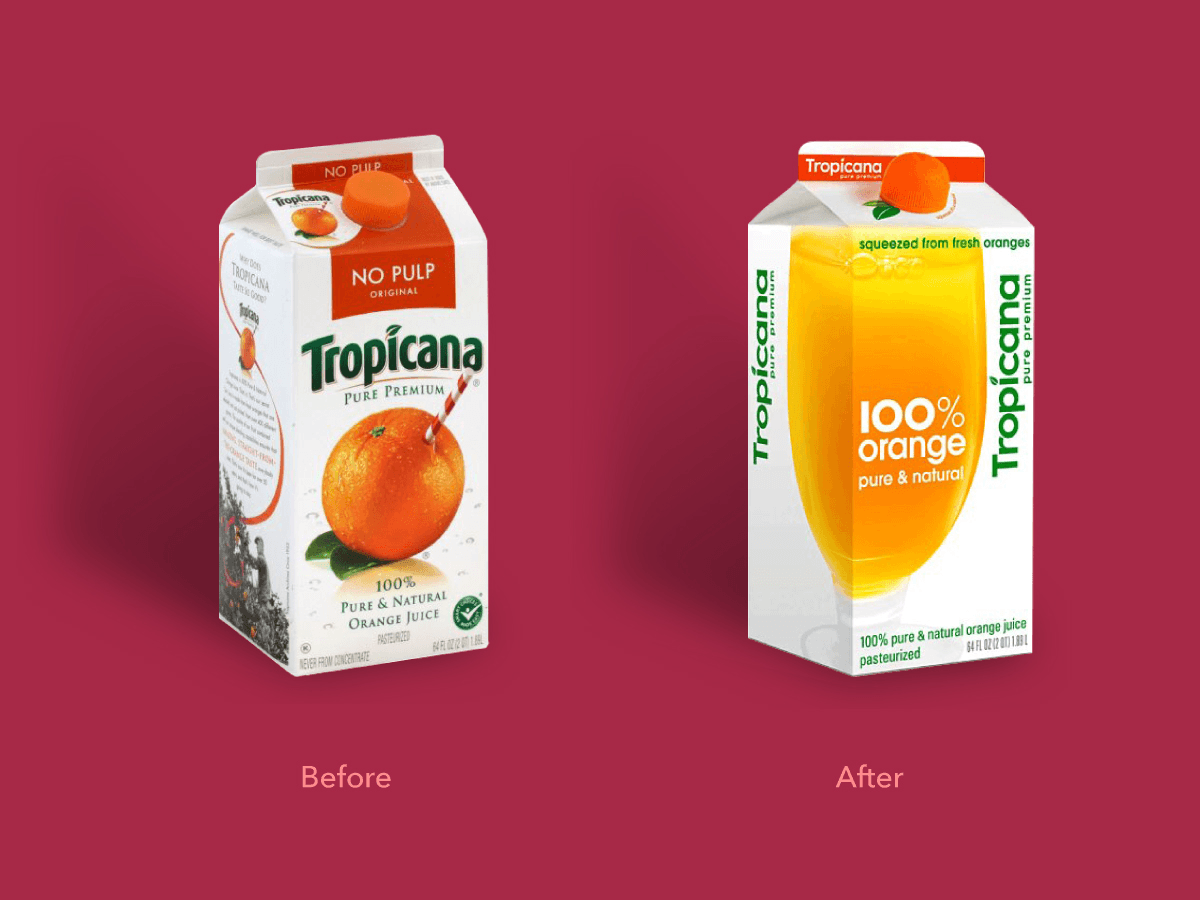
In attempting to change their image to a more modern style, Tropicana underestimated visual communication, releasing a design that challenged the user. While putting an image of a glass of juice on the packaging sounds logical for an orange juice brand, it created a roundabout path for product recognition. In a supermarket context, where the product sits among many competitors, choosing another brand is faster than analyzing imagery or searching for the familiar "orange with a straw" packaging.
Stories of designs going the wrong way and affecting brands are not new, and market share acts as a multiplier for those failures; the larger the brand, the higher the damage. While Tropicana lost $65 million for a packaging design, in 2006, Mastercard lost $1.5 million for a new logo only to revert to the old one because the new design was so poor. Similarly, in 2010, when Gap announced a logo change, it received a wave of criticism that caused the new logo—with an estimated cost of $100 million—to be pulled down after only six days of use.
Reality has proven that design does not only affect customer sentiment toward a brand but also directly impacts the revenue and profit of that brand. Graphic design is not just about technique or aesthetics; hidden beneath it is research and strategy. The role of design should be understood correctly, and designers should be empowered to work correctly—having access to information about the market, customers, and competitors. This ensures that the design products released to the market possess not only aesthetic value but also intellectual and strategic value, ultimately benefiting the business.